
June 16, 2026 • By Dr. Sadok Derouich
Why generic EMRs fail OB/GYN specialists — and what to look for instead
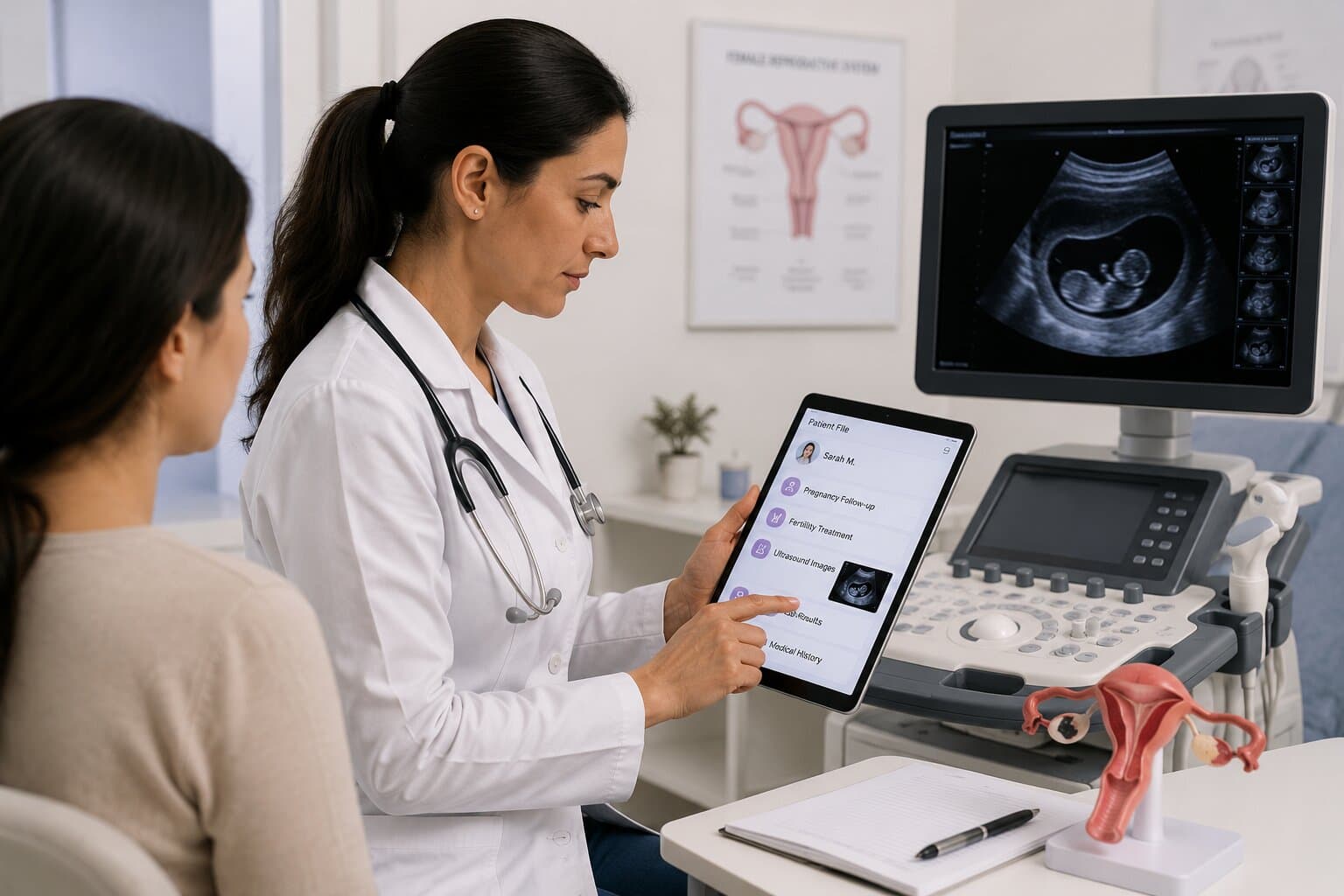
A general-purpose medical record was never designed to hold a pregnancy, a fertility protocol, or an ultrasound image — and OB/GYN practice runs on all three.
Generic EMRs fail OB/GYN specialists because they were built around a single open-ended patient file — not a 9-month pregnancy timeline, an ultrasound-heavy workflow, or a fertility protocol that needs structured tracking. The result is data that gets lost, copied by hand, or never connected to the alerts that would have caught a missed test. In the case for a doctor-led dev team, we argued that clinical judgment needs to be present at every technical decision point in medical software. This article applies that principle to a specific terrain: a specialty-built EMR has to be designed around how gynecology, obstetrics, and fertility medicine actually work — not adapted from a template meant for general practice.
What you will learn in this article:
- Why ultrasound integration is the single biggest gap in generic EMRs for gynecology
- How a pregnancy-specific timeline catches missed milestones that free-text notes cannot
- Why cervical and breast cancer screening need their own tracking logic, not generic reminders
- What a fertility-specific template must capture — from investigations to ovarian hyperstimulation charts
Clinical Perspective
One of the documents my patients value most is something I generate automatically from their record: a personalized follow-up calendar, built from their last menstrual period, that lists the exact week ranges for every key investigation in their pregnancy — including the narrow window for nuchal translucency measurement. It takes the EMR seconds to produce. It takes a generic system, or a paper agenda, nothing — because it was never built to think in pregnancy weeks.
Why Ultrasound Integration Is Non-Negotiable for Gynecology Records
A consultation that does not involve an ultrasound is the exception, not the rule, in obstetrics and gynecology. Yet most EMRs treat the ultrasound machine as a separate device, entirely disconnected from the patient file.
That gap creates two outcomes, and both are bad. A doctor who is too rushed to manually re-enter every measurement from the ultrasound screen into the patient file simply will not do it consistently — the data either stays only on the ultrasound machine's hard drive, or gets summarized from memory after the fact. Eventually, the machine's storage fills up and old studies are overwritten or deleted, taking irreplaceable findings with them. A more meticulous doctor will do the manual transcription every time — measurements, fetal biometry, follow-up notes — but at a real cost in minutes per consultation, every single day, for years of practice.
There is no good version of a generic EMR here. You either lose time, or you lose data.
| Feature | Generic EMR | OB/GYN-specific EMR |
|---|---|---|
| Ultrasound images | Stored only on the machine, separate from the patient file | Automatically imported into the patient record |
| Measurements (biometry, NT, etc.) | Manually retyped by the doctor, or skipped | Captured directly with the image, no retyping |
| Long-term storage | Limited by the ultrasound machine hard disk | Stored permanently in the cloud patient record |
| Patient access to images | Printed copy or nothing | Shareable directly from the patient record |
A specialty EMR built for gynecology cannot treat ultrasound integration as an add-on. We go deeper into what that integration should look like — and how it was implemented in practice — in an upcoming article on connecting ultrasound machines directly to a gynecology EMR.
How a Pregnancy-Specific Timeline Prevents Missed Obstetric Milestones
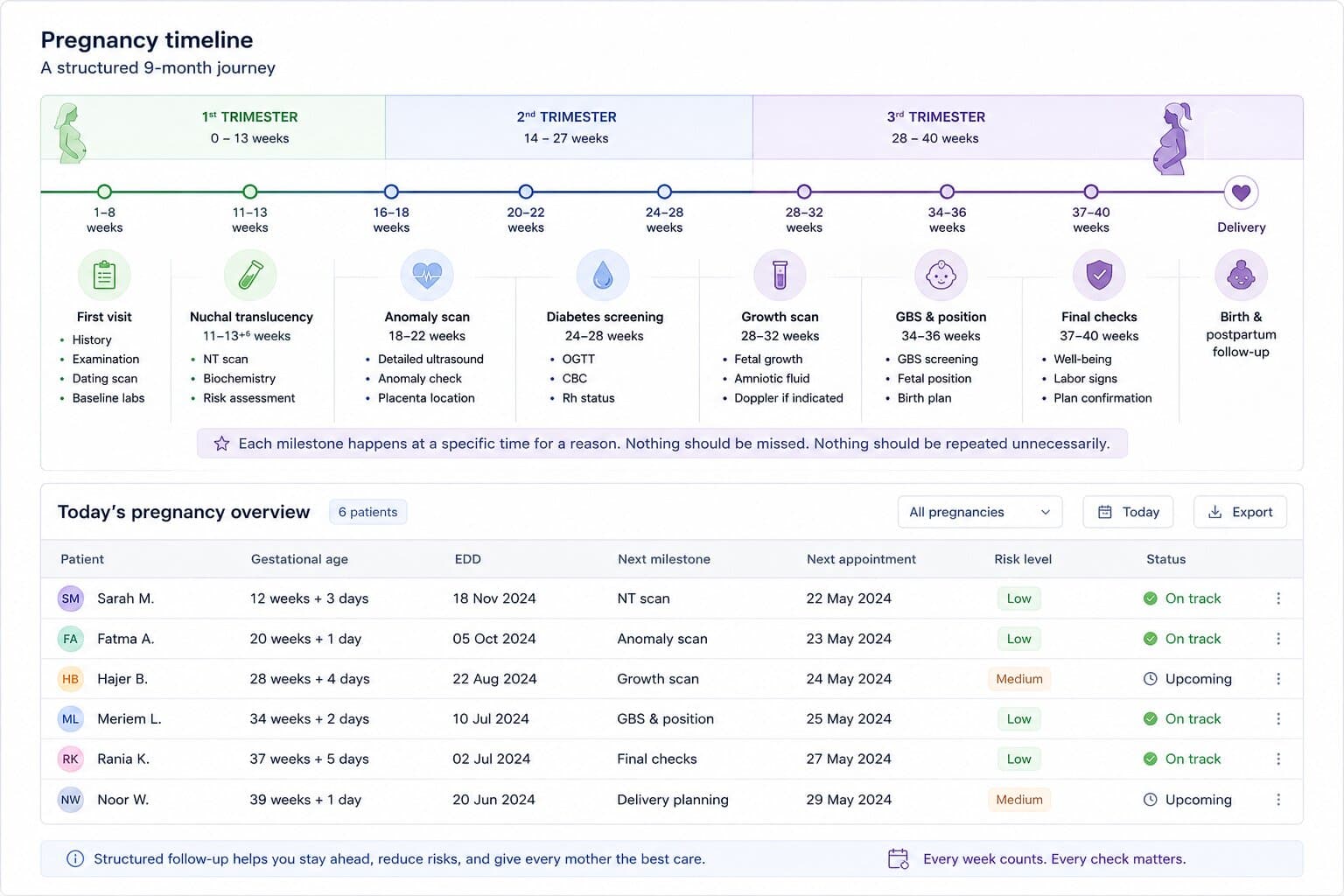
Obstetric follow-up is not an open-ended record — it is a fixed nine-month window with specific investigations at specific times, and it needs a record structured the same way.
Obstetric follow-up is fundamentally different from most specialties: it runs on a fixed, roughly nine-month clock, with investigations that are only valid inside narrow time windows. Nuchal translucency measurement, for example, can only be performed between 11 and 14 weeks of gestation — outside that window, the test cannot be done at all, no matter how good the intent. A medical record built as an undated list of consultations gives the doctor no structural way to see, at a glance, whether that window is closing.
A pregnancy-specific EMR needs to do two things a generic system cannot. First, at each individual visit, it should surface an immediate overview of where the pregnancy stands against the expected timeline — what is due, what is overdue, what flags need attention right now. Second, at the level of the whole practice, the obstetrician needs a single view of every pregnancy currently being followed, with expected delivery dates, to plan deliveries, staffing, and follow-up visits across the entire patient panel — not just the patient in front of them.
Some investigations compound this complexity further. Maternal serum marker screening, for instance, only makes sense combined with specific ultrasound findings from the same gestational window — which means the EMR needs a template built specifically to hold both data types together, not a generic lab-results field.
Clinical Perspective
Two of the most common gaps I have seen in obstetric follow-up are entirely preventable: forgetting to prescribe monthly toxoplasmosis serology for a non-immune patient, and forgetting to stop low-dose aspirin at the appropriate point in a patient with a preeclampsia history. Neither failure is about a lack of knowledge — every obstetrician knows these rules. It is about memory, under time pressure, across hundreds of consultations. A dedicated EMR turns both into programmed alerts tied to the patient's specific risk profile and gestational age, rather than something the doctor has to remember unprompted at every single visit.
This is not a hypothetical risk. Even in countries with a long-standing mandatory monthly toxoplasmosis screening program, real-world adherence to the full recommended testing schedule has historically fallen well short of target — in one national surveillance study, only around a third of non-immune pregnant women received the full recommended series of tests, with roughly a third stopping after the first trimester entirely. A study on toxoplasmosis screening implementation documented this adherence gap directly, even where the screening was formally mandated. Structuring the data so the system itself tracks what is due — rather than relying on the doctor to remember case by case — is what closes that gap.
Why Cervical and Breast Cancer Screening Need Dedicated Tracking
Gynecologic follow-up outside pregnancy carries its own structural challenge: screening intervals that are measured in years, not weeks, which makes them easy to lose track of in a generic appointment system built around "next visit" logic rather than "next due date" logic.
Cervical cancer screening and breast cancer screening both follow interval-based protocols that depend on the patient's age, history, and prior results — not a fixed calendar date set by the last visit. A generic reminder system that simply prompts "schedule a follow-up in 12 months" cannot represent a 3-year cervical screening interval that resets differently after an abnormal result, or a mammography interval that changes with family history. This needs to be a structured, patient-specific field the EMR actively tracks and surfaces — not a note buried in free text from two years ago that the doctor has to remember to reread.
What a Fertility-Specific EMR Template Must Capture
Fertility follow-up is arguably the most structurally demanding workflow in gynecology, because it is not a single linear timeline like a pregnancy — it is a sequence of investigations, a strategy decision, and an execution phase that often repeats across multiple cycles.
A fertility specialist needs, at minimum, an immediate overview of which investigations have already been completed and which remain outstanding for a given patient — not a search through scattered lab reports to reconstruct that picture each visit. Beyond the investigation phase, the record needs to hold the chosen strategy and management plan distinctly from its execution, so that a change in protocol mid-treatment is visible rather than buried in a chronological note.
Ovarian hyperstimulation monitoring is the clearest example of why fertility needs its own templates entirely. It requires a highly specific, repeated-measurement chart — follicle counts, sizes, and hormone levels tracked across multiple visits within a single cycle — that has no equivalent structure in a general consultation template.
There is also a research dimension that generic EMRs structurally cannot support. Evaluating which protocol works best requires consistent, structured data collected the same way across every patient and every cycle — not free-text notes that vary by doctor and by day. If outcome data is not captured in a structured, comparable format from the start, it cannot be analyzed later, no matter how good the underlying care was. We cover the specific design of a cycle-tracking and ovarian hyperstimulation template in more depth in an upcoming article on building a fertility-specific EMR template.
What to Look For When Evaluating an OB/GYN-Specific EMR
If you are comparing a general medical record system against one built specifically for gynecology, obstetrics, and fertility, here is what should be non-negotiable:
- Does it import ultrasound images and measurements automatically, without manual retyping?
- Does it give an immediate, at-a-glance view of where each pregnancy stands against its expected timeline?
- Does it offer a single overview of all pregnancies in the practice, with expected delivery dates?
- Does it generate programmed alerts for time-sensitive protocols — toxoplasmosis serology, aspirin timing, screening intervals — tied to each patient's specific risk profile?
- Does it support dedicated templates for fertility investigations, strategy, and ovarian hyperstimulation monitoring?
- Can the patient receive their own ultrasound images directly and instantly, without a printed copy?
When I built doctoGyn, this list was the actual starting brief — not a feature checklist added after the fact, but the structural requirements that shaped how the record itself is organized from day one. Patients consistently tell us that being able to receive their baby's ultrasound images instantly, straight from the consultation, is one of the things they value most — and it is only possible because the record was built to hold and share that image in the first place, not bolt it on afterward.
This matters even more for OB/GYN specialists practicing outside the US and Europe, where most specialty EMR development has historically been concentrated. A gynecologist in Tunisia, across Africa, or in the Middle East faces the exact same need for ultrasound integration and structured pregnancy tracking as a colleague in Paris or Boston — but has rarely had software built with that reality in mind, let alone priced for a solo or small practice rather than a hospital department.
Frequently Asked Questions
Why can general-purpose EMRs not handle ultrasound integration well?
Most general EMRs were designed around text-based consultation notes, not imaging devices. Connecting an ultrasound machine so images and measurements import automatically requires the record to be built around that workflow from the start, which most general systems never were.
What makes pregnancy follow-up different from other specialties in an EMR?
Pregnancy follow-up runs on a fixed, roughly nine-month timeline with investigations valid only in specific gestational windows. A record needs to track this timeline structurally so it can flag what is due or overdue, rather than relying on the doctor to remember it from an open-ended note history.
Can a generic EMR support fertility treatment tracking?
Generic EMRs can store notes about fertility treatment, but they cannot represent the structured investigation-strategy-execution workflow or repeated-measurement charts like ovarian hyperstimulation monitoring without a purpose-built template.
Why do programmed alerts matter more in obstetrics than in general practice?
Obstetric protocols like monthly toxoplasmosis serology for non-immune patients or aspirin timing for preeclampsia risk depend on the specific risk profile and gestational age of each patient. A system that tracks this structurally can flag a missed or upcoming action automatically, rather than depending on the doctor remembering it unprompted at every visit.
Can patients receive their ultrasound images directly from an OB/GYN EMR?
In a record built around imaging integration, ultrasound images can be shared with the patient instantly from the consultation, instead of relying on a printed copy that can be lost or damaged.
An EMR built around how OB/GYN actually works
doctoGyn integrates ultrasound, pregnancy tracking, and fertility templates by design.
Written by Dr. Sadok Derouich, a practicing gynecologist since 2012, digital health entrepreneur, and CEO of doctoGyn — the AI EMR built exclusively for gynecologists, obstetricians, midwives, and fertility centers.

About the Author
Dr. Sadok DerouichDr. Sadok Derouich is a practicing gynecologist since 2012, digital health entrepreneur, and CEO of doctoGyn — the specialized EMR built exclusively for gynecologists, obstetricians, midwives, and fertility centers.
View Derouich's profile →Stay Updated
Get the latest insights on AI in medicine delivered to your inbox.